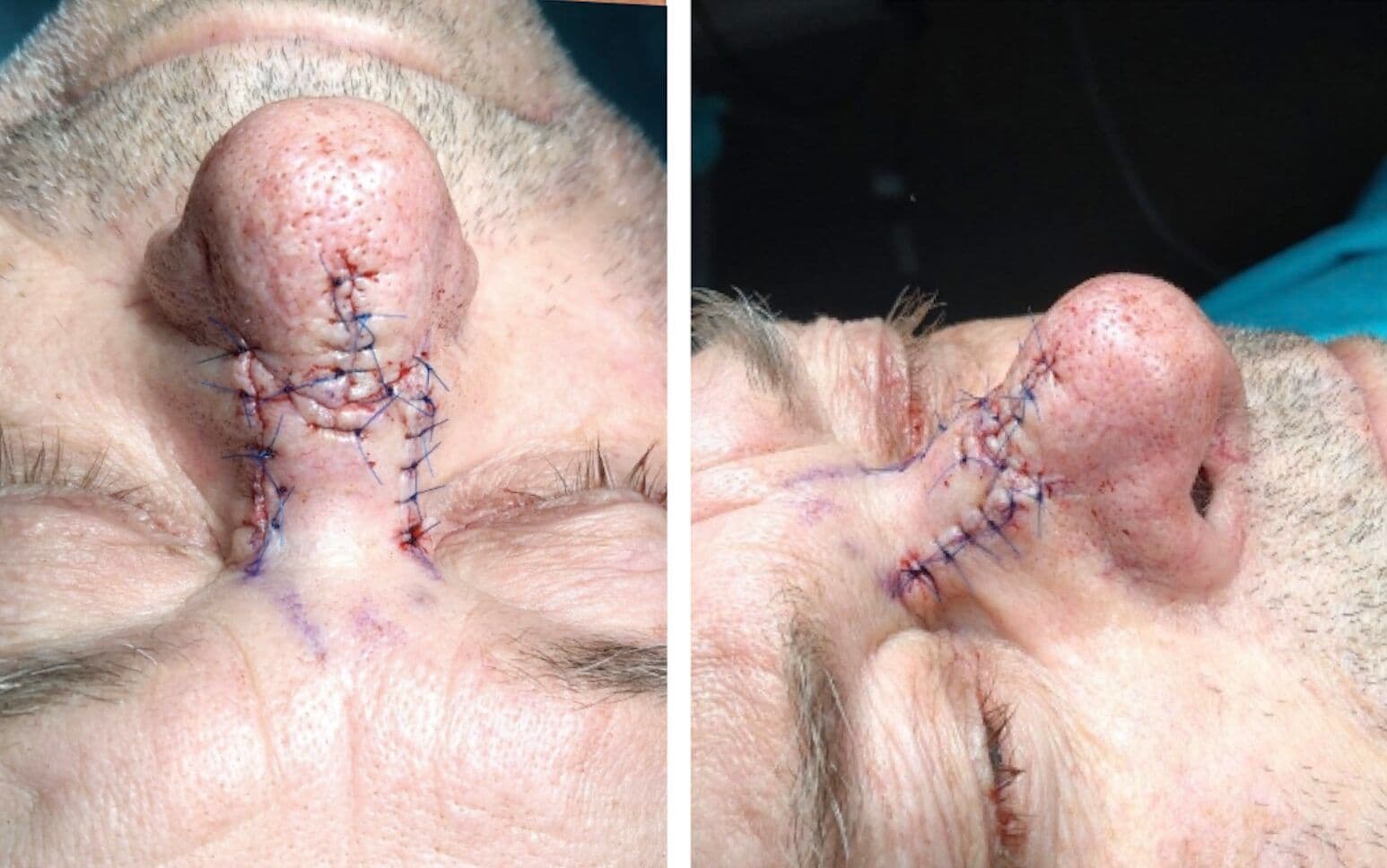
Case 26 2026: Dual-Hybrid Flap Advancement for Proximal Dorsal Nasal Reconstruction
Lukas Kure-Rosenberg, Magnus Balslev Avnstorp
Background: Proximal dorsal nasal defects are commonly reconstructed with glabellar advancement flaps. However, in selected patients with favorable distal tissue mobility, alternative local strategies may provide equivalent reconstruction while preserving aesthetic subunits thus minimizing scar burden. Case Presentation: An 84-year-old male underwent oncologic excision of a 13-mm moderately differentiated squamous cell carcinoma of the proximal nasal dorsum. The resulting full-thickness defect extended toward the nasal bulb. Preoperative assessment showed significant bulbous skin mobility and distal redundancy without prior surgical scarring. Methods: Instead of glabellar recruitment, reconstruction was performed with a hybrid local advancement strategy combining Peng-inspired medialization with a limited Rintala/H-type advancement component. Tissue was mobilized in the subcutaneous plane to preserve the subdermal plexus, and distal advancement was maintained lateral to the midline to protect dorsal contour symmetry. Results: Flap perfusion remained stable, with no ischemia or venous congestion. At the two-month follow-up, the patient showed a preserved dorsal contour, symmetrical nasal lines, and satisfactory scar placement, without trapdoor deformity or tip distortion. Conclusion: Selected proximal dorsal nasal defects can be reconstructed with hybrid local advancement techniques that strategically exploit distal tissue redundancy. Context-driven modification of established flap principles may allow avoidance of glabellar flaps while maintaining excellent functional and aesthetic outcomes. Patient medical history An 84-year-old male was referred to the Department of Plastic Surgery at Roskilde Sealand University Hospital, Denmark, in winter 2025 by a dermatologi