
Case 10 (2023): 1st dorsal intermetacarpal artery flap (Foucher flap)
Andrea Wenger, Volker J. Schmidt

 AfterBefore
Key learning points
Pearls
- Sensitive flap. Short immobilisation with good range of motion. Regional reconstruction of the tissue. Microsurgical experience is helpful. Preserve paratendineum at the donor site.
Pitfalls
- Venous congestion – especially in cases of island flap design. (Partial) flap loss (
Patient history
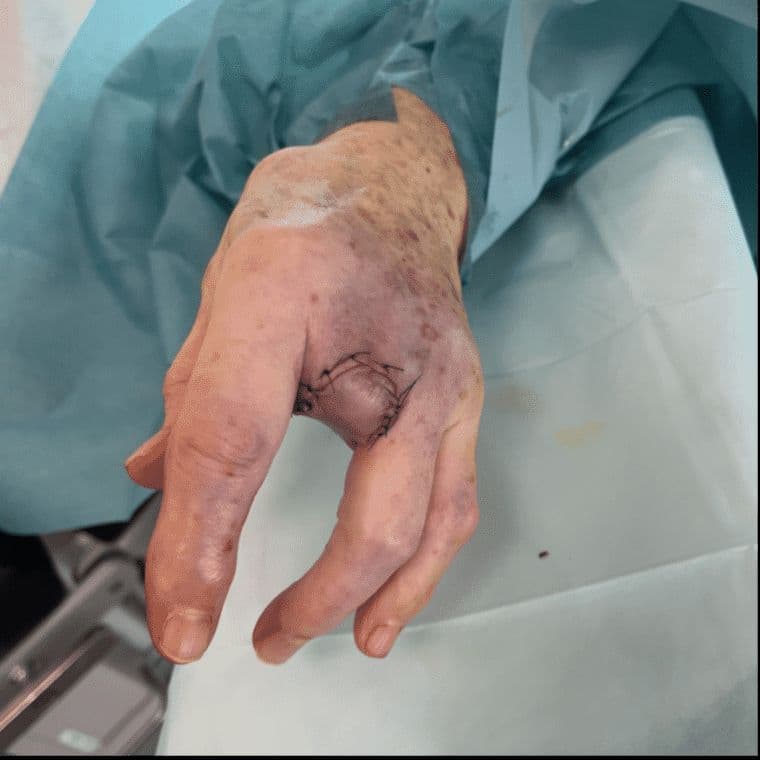
Initially, the patient presented with a purulent tenosynovitis of the right thumb. Debridement was performed and antibiotics for streptococcus pyogenes administered. 3 weeks later we did another revision surgery because of infected necrose tissue at the pulp of the thumb and osteomyelitis of the terminal bone. After two more debridements this resulted in a soft tissue defect at the palm of the thumb. A gentamycin foam was placed inside the bone and iv antibiotics given although the bacterial cultures were negative.
Patient Examination
General medical history: 62 year old otherwise healthy male patient with no history of comorbidities (e.g. diabetes), no allergies, non-smoker, no regular intake of any medication Profession: self-employed caretaker, right-handed Right Hand: Skin defect at the palm of the thumb, 2 x 3 cm with exposed bone, FPL tendon, radial and ulnar nerve. EPL and FPL function intact, thumb warm and blood flow intact, 2 point discrimination at the radial side not measurable, 5mm at the ulnar side. X-ray showing signs of osteomyelitis, the IP joint intact
Pre-operative considerations
Since the patient was young, healthy, right-handed and a self-employed manual worker, the need of a mechanically robust pulp was the reconstructive goal and amputation at the IP level was no option. 2 flaps would be an appropriate choice for closing this defect: a first dorsal intermetacarpal artery flap or a sensory heterodigital island flap (e.g. ulnar pulp of the ringfinger). Our choice against the latter was due to the history of infection and osteomyelitis with potential risk for further complications and the defect presenting mainly at the radial and therefore the non-dominant part of the pulp in precision grip. The first dorsal intermetacarpal flap (commonly known as Foucher flap) has been initially described by Hilgenfeldt, was designed as a racquet flap by Holevich and modified as an island flap by Foucher. For safety considerations we decided to take a small skin overlying the pedicle and include as many subcutaneous veins as possible in the flap.
1How to cite this article
Andrea Wenger, Volker J. Schmidt. Case 10 (2023): 1st dorsal intermetacarpal artery flap (Foucher flap). Journal of Plastic, Breast & Reconstructive Surgery. 2023. https://jpbrs.com/cases/1st-dorsal-intermetacarpal-artery-flap-foucher-flap-2023
Open access. © 2023 The Author(s). Published by the Journal of Plastic, Breast & Reconstructive Surgery. Copyright to this case is shared between the author(s) and the journal; authors may reuse their own case for education, presentations and social media.
Keep reading


Comments
Comments from signed-in readers, shown after an editor has approved them.
No comments yet.
Sign in to comment on this case.