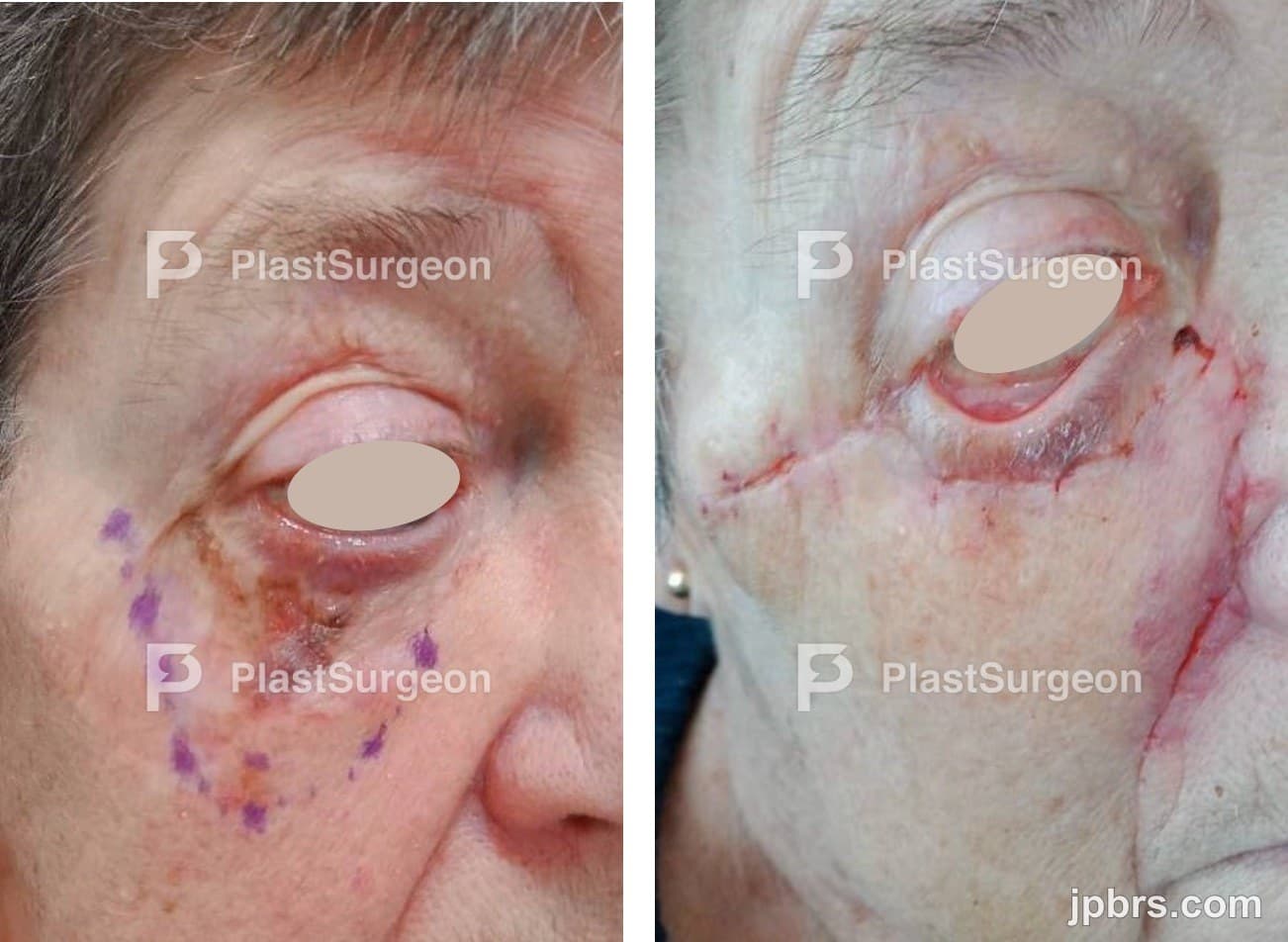
The patient underwent an incisional biopsy, confirming the presence of lentigo maligna melanoma. Due to its location and mild exophthalmos, the possibility of local spread to the orbit was considered. Subsequent MRI imaging of the orbit revealed partial to diffuse contrast enhancement in the area, with no signs of invasion into the orbit. Therefore, orbital involvement was ruled out, allowing for further surgical planning, as the condition presented with localized superficial dermal involvement, for which primary treatment is surgical excision. Considerations regarding alternative treatment options included local oncological treatment.
The first surgical procedure involved excision of the LMM and reconstruction with a cheek rotation flap. Unfortunately, the excision margins were not free, and the patient developed ectropion og the right lower eyelid.
Upon re-excision, this should involve nearly the whole lower limbus edge and a part of the upper limbus edge, which could not be reconstructed using a single flap. The location of the lentigo maligna melanoma (LMM) necessitated comprehensive reconstruction, involving the lower limbal edge, conjunctiva, upper and lower eyelids, as well as the cheek. An important part of the deliberations focused on how to reconstruct these structures.
The optimal solution, In this case, involved a tarsconjunctival flap for conjunctival reconstruction, a fascial turn over flap from the temporal muscle to reconstruct the canthus and upper and lower limbal edge, and a skin transposition flap from the temporal region for upper eyelid reconstruction, and a full-thickness skin graft to close the remaining central defect.
Particularly with extensive surgery, perioperative complications must always be considered. Therefore, it is crucial to provide comprehensive information and considerations to the patient. In this procedure, there were risks of bleeding, infection, noticeable scarring, incomplete excision necessitating further treatment, flap loss, skin graft failure, wound rupture, vascular and nerve damage, sensory disturbances, re-excision for residual tumor, ectropion, and other eyelid problems.
1